A few nights ago I was walking along near Union Seminary in NYC, and passed this mailbox with a graffito'd image of Marcel Proust, the writer of writers; author of one of the world's longest novels (À la recherche du temps perdu). And I thought that I ought to snap a photo for my co-travelers in the bibliosphere. There are, admittedly, many odd, novel, and curious things out along the byways and streets. And this seemed to fit nicely into our transient conversations about books. On to the next bit of biblio-novelty!
A Visit to an Off-the-Beaten-Path Book Shop: The Bohemian Book Bin
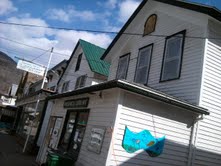
For some time, I'd wanted to check out a bookshop that someone had mentioned to me last autumn. Over the winter, during one of those quiet, grey-sky weekends, I decided to take a drive to this place--the Bohemian Book Bin, located in Lake Katrine, NY (it was previously located just south in Kingston proper). It's a curious little place, on a side road off of Route 9W. The few times I'd looked for it, I couldn't find it, until someone pointed out the very small, black-and-white sign hanging in a parking lot a distance away from the shop. The sign was at least 500 feet, if not more, from the shop itself. And one cannot actually see the shop from the main road, because it is hidden by a slight hill and rock formation. But if you drive up the side road, you'll see to your right, a little industrial garage style building, with the nice little sign hanging out front, which reads "Bohemian Book Bin."
The front of the building is curiously decorated with an old church pew, an ink-well desk from some old single room school house, and piles of books. As you can see, there was a little snow on the ground the first time I found the place. And still, the books were outside. The shop was closed, and so I had to return another time. When I did I found that the inside looked a bit like the outside in its appearance, a bit grungy and disorganized. This is not to say "totally" disorganized, but books were piled haphazardly everywhere around the store. Admittedly, this sort of bookstore design has its benefits and can be attractive to book-hunters. I know that I like finding little nuggets and goodies in piles of books, that might otherwise be missed. Inside the shop was a little dark and musty, but it had an interesting and otherwise charming feel. They played some good music over the speakers, and the young woman who was the cashier and clerk was friendly and helpful.
The first day I went, the website said they were open, but in fact they had posted some different hours on the door, so when I arrived they were closed. I would recommend people to visit the shop and see what treasures may be had inside. The best sections, in my opinion, were toward the back of the shop, which was in better order. But if you go, give them a call first, to make sure they are open.
Early on the morning of Saturday, March 19th, 2011, the Phoenicia Public Library (~13.5 miles from Woodstock, NY) had a major fire, which gutted a good portion of the building it was occupying. An article (see here) appearing in the Daily Freeman newspaper was forwarded to me, and I decided that I'd go up and take a look to see what had happened and what the next steps the town had to resurrect its library. The following Saturday, March 26, I drove up to Phoenicia with my mother, into the cool air of the mountains on an early spring afternoon. The sky was blue and the temperature was probably just ten degrees above freezing. But it was fresh air. And the sun shined brightly.
Driving into town, we actually first found the "new" library, which had a nice big sign out front, and which you will see further down in this posting. The photos you see here are actually from the burned library, mostly out front. It was located on the main thoroughfare going through Phoenicia. The "new" temporary library is housed in an old medical arts building. I went in and found a group of people chatting. I asked what was happening and met the very friendly and helpful local librarian & director, Tracy Priest, who told me that they were trying to get things set up in the building as best as they could. I'll return to this conversation shortly. But I wanted to show some of the original library here at first.
Ms. Priest told me where I'd find the original library, and cautioned me about being careful. So, when I went back onto the main street, I just took photos from the front and side, and didn't go near any of the potentially dangerous areas of the building. Here you can see some of the burned building and materials that were tossed out the side...including some burned equipment, computers, and books.
The front and side of the original library, which burned. Below, a reminder of the "Best Library Ever!" posted in the window, as seen from the front.
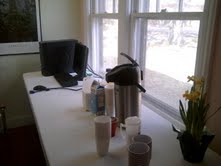
Back to the "new" library space (above)--I had a nice conversation with Ms. Priest, and took a quick tour around the nascent little library. Considering the circumstances, the resilience of the Phoenicia Library is remarkable. Though, there were probably only a hundred or so books available, everything seemed to be in full motion--moving toward a well-functioning new library. Above, we see a table with a computer and some welcoming coffee...for visitors that Saturday, when I visited.
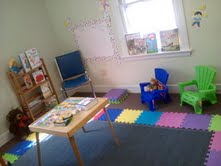
Above, a shelf of local and Catskill history. Below, the children's room.
I found the image of the library's logo of a bear reading on some Adirondack chairs quite charming. They put the image on some t-shirts, as well as out front of the new library. See the images below...
Below is the new library location. It was a great pleasure to meet the folks in Phoenicia, and to see what a strong spirit they had after this devastating fire. Phoenicia, which has been known to suffer devastating floods from time to time (as they are located in a floodplain), has been resilient once again after this tragedy.
For those interested in helping, monetary donations can be sent to the Phoenicia Library (Temporary Location), 9 Ava Maria Drive, P.O. Box 555, Phoenicia, NY 12464, or to the website (http://phoenicia.lib.ny.us). See also the Facebook Page "Phoenicia Librarians." If you would like to call the library, the number is 845-688-7811. We wish Phoenicia all the best in their work to rebuild their library and community gathering space!
Almost Siberia, Books Find Home in Prison on Central Asian Steppe
This piece is long in coming. Just about a year ago, my good friend Soren Johnson traveled to Kazakhstan on a prison visitation trip with his organization, Prison Fellowship International, where he is Senior Vice President. He travels around the world investigating prison conditions and how prison ministry works (or not) under various systems of penal incarceration. He'd once told me how when entering into a Polish prison a year or so before he traveled to Kazakhstan, he'd found an enormous library, with countless volumes. But each volume had no title or name on its cover or spine; rather each had distinct numbers, like nameless prisoners from the Gulag! It was both stark and surreal. Such activity makes one wonder how closely we often associate books with people, in this case almost like prisoners with numbers!
When Soren told me of his upcoming travels to Kazakhstan, especially to a prison, I seized on the opportunity to see if there were any libraries involved or attached to the institution he was visiting. When he informed me there was, I was excited and told him to take some photos if possible and report back to me what exactly he'd seen. Books in prison have been widely seen as the prisoner's great companions, yet some (perhaps many) prisons in less hospitable climes and cultures are likely to be without such amenities or "luxuries." To have a library in prison is really even more remarkable. In this country, there are programs like the Prison Library Project, which was started in 1973, for example. The history of the actual "prison library" in the U.S. goes back to the early 19th century. In a masterful paper by Rhea Joyce Rubin, titled "U.S. Prison Library Services and Their Theoretical Bases" one can find a rich history of books and libraries in American prisons. As Rubin writes: "In 1790, the Philadelphia Prison Society began furnishing books to the inmates in the Walnut Street Jail and book service to prisoners began," (3). The first prison library, apparently, was constructed about a dozen years later: "1802 marks the first library in a state prison. The Kentucky State Reformatory established a small library, primarily of religious books, which was administered by the chaplain," (3).
Now, because of the punitive nature of many prisons and legal systems around the world, the idea of a library could be considered luxuriant. I'd had different conversations with individuals who'd spent time, for example, in Jamaica. And the reports about the state of prisons in that island nation, especially in the early 1990s, were devastating and atrocious. But in an exchange I had with an official working in prisons in and around Kingston, Jamaica last year, I was pleasantly surprised to hear reports to the very opposite. According to one gentlemen, who'd been into help with prison chaplaincy, some of Jamaica's most high- or maximum security prisons had the best prison libraries and computer centers he'd ever seen! And this may be something to consider when looking here at these photos of the Kazakh prison, in the city of Astana--the second largest city in Kazakhstan, with a population of about 700,000, and located in the northern province of Akmola.
In these photos, you will find a number of resources for the prisoners at the prison, including periodicals, newspapers, and a whole array of reading materials.
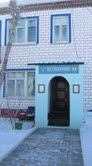
Going back to the first photo, you may notice the Cyrillic characters spell out the Kazakh word for "Library," which interestingly reads something like "Kitab'-," clearly from the Arabic root for the word for "book." The fluid and confluent nature of language travel and exchange over geographic locations is quite evident in a word like this. There are other signs in Russian or Kazakh scattered around the library, as you will see below. In the accompanying photo here, you will see informational, catalog, or borrower cards. At this point, I will turn over to some of the reporting that my friend Soren did, and provide some raw data on the institution and the library itself. Here are some notes from Soren:
"Kazakh prisons are numbered. (For further detailed information on this, see the following link: (http://www.kcl.ac.uk/depsta/law/research/icps/worldbrief/wpb_country.php?country=98). This visit was to prison 166/10 in Astana, built in 1971, and which currently holds 764 inmates. I toured this in the course of my work with Prison Fellowship International. It's located in a separate out-building within the general prison "yard"--a multi-acre space which includes gardens, a mosque, a chapel, etc. The sign above the door [see above] says 'library' in Kazakh. When I walked in I found a reading room, with periodicals available. Then you walk through it and enter a second room which is where all the books are located. 8,000 books total. 300 ordered last year. If a prisoner wants a book and the library doesn't have it, the prisoner can arrange to pay for it through his account (if he's saved up money--some 25% of prisoners have the equivalent of FT jobs on the prison grounds, paying about $100 a month).
Inmates are on rotation, basically staffing the library. I took a picture of a box of their library cards--which are pieces of paper just folded in half, with the inmate's name, and what books they've checked out. If you check out a book, you record the info on your card and leave it on the desk and they file it by last name. There's no numbering system on the spines...it's all pretty much alphabetical, by last name of author. I asked if they had Solzhenitsyn's Gulag Archipelago and they said they did, but couldn't locate it (that would have been a great photo!). I asked what was most popular: the inmate/librarian said crime-fiction ("detecktivy"), novels, romance, books on law, English language how-to, collections of correspondences, poetry. They seemed to have a pretty big Russian Literature section. Books were primarily in Russian with some Kazakh as well. As prisoners have free time during the day between and after studies and work, they can and do come to the library. The inmate/librarians said that there are about 150-200 regular users (which is up to about 25% of the inmate population), with 10-20 visitors per day.
Other than the above factoids, I was generally impressed by the order of the library, the librarian's interest, the fresh looking periodicals and newspapers. One prison officer told me that a few years back, all the guards got together and each brought five books that they weren't using at home, and they were able to boost the number of books at the library. Besides the main library there are also 'mini-libraries' around the prison comprised of just one or two shelves. Examples of these could be seen in the Protestant chapel, the Catholic chapel, the Orthodox chapel, and the mosque.
By the way it was 40 BELOW zero Celcius during my visit to the prison! ...[it is fascinating] how prisons are microcosms of society. Each prison I saw had miniature approximations of what we find on the outside. If Dostoevsky or Mandela each basically said that a prison reveals the 'soul' of a country, we could narrow this down in some way and make some educated generalizations about the nation's culture in light of its prison libraries, no?"
I don't think I could have said it better! I really want to thank Soren for his contribution here today. There's a lot that I think we can continue to learn and take away from such little nuggets of information (often hidden information). The other interesting item here is that there is a fairly sizable amount of fluid information here: the idea of what freedom is or may be can be examined by even the freedom of information provided to prisoners. Freedom of space is one thing, while freedom of knowledge and information is another.
Soren had a good trip and was able to connect with an old Kazakh friend of mine, whom I went to college with, and who now lives back in his home country. Now Soren is back home in the U.S., doing the great job he always does. There may be some future collaborations between us, and we're looking forward to exploring the nature and extent of the international prison library phenomenon further. We hope this has been insightful and useful. Please let us know if you have any questions, and we'll try to answer them as we can. For now, back to reading...and back to those companions we call books!
I'm not sure how surprised I was when I came across this little treasury of garlic books. Actually, it was a pile of garlic recipe and cook books. But it was a pleasure, nonetheless, to stumble onto a pile of bookish items as these. Last autumn, in the small but every-expanding town of Saugerties, where I have roots that sink into this old Dutch-American earth more than a century and a half, there was the annual Hudson Valley Garlic Festival. I hadn't been in years, and had a hankering for some garlic specialties. The festival has been going on for more than 25 years, and I do remember some of the earliest gatherings, which didn't have the tens-of-thousands of folks it now attracts.
In fact, in the accompanying photo here (right near the books about garlic), you might be able to spy the "Garlic Queen" (Pat Reppert), who has often called (or "styled") herself as the "Goddess of Garlic." That sounds mighty exotic! Anyhow, we chatted briefly, and she's a very lovely woman, who also happens to be the founder of the Hudson Valley Garlic Festival. The first festival was held at her house here in Saugerties in the mid-1980s.
Over the years the festival has grown considerably. I remember one unofficial count being somewhere around 60,000 visitors in one weekend! That means the village of Saugerties swells many, many times its actual size. Lots of traffic.
Perhaps the most curious thing about this festival is how many things are "laced," "concocted," "baked," "cooked" or my favorite--"infused" with garlic. As you can see above: Garlic Chowder.
The general experience at this festival was pleasant, except it was VERY crowded and hard to walk because of this. (There were great blue-grass style bands, puppet-theater, and cooking classes!) The only issue that some might feel offended by was the smell. You see, even as I approached the municipal fields where the festival was held, you could feel the impending garlic cloud floating mouth-high and surrounding you just as you entered. It wouldn't have been so bad if it were the fresh or cooked garlic, but this was the garlic smell of 30,000 people off-gassing their garlic-infused comestibles! Probably the least offensive items were the jellies or honeys (as seen above with many bee friends).
Many vendors drove in to sport their wares and sell garlic-stuff. I had my eyes (and stomach) set on the garlic ice cream. I will admit, I've pined for this delicacy for years, maybe as many as twenty years, since I went to the garlic festival back during my High School days. But let me tell you, this was not something you bring to your grandmother. It was pretty bad. And I like trying all sorts of so-called exotic foods. The problem with this sample, at least, was that the garlic was processed garlic--the kind you get in a big can or bottle that's diced into micro-squares, and then dumped into a vat of vanilla ice-cream.
Folks, I'd say stick to the books. Make your recipes at home. No sense adding to the public garlic cloud, like I did after that ice cream! But if you insist: go to the next garlic festival. It's surely an adventure all its own.
Over the past month, newspapers, magazines, and radio stations promoting the 1987 opera "Nixon in China" by John Adams have used a handful of curious phrases to describe the piece; usually either "ground breaking" or "path breaking." I'm not sure if either of these terms really work or make sense. I mean, don't get me wrong, this is one of the great operas out there, and it is one of my personal favorites. And I think that Adams is a marvelous composer. But it is in the way that many in the contemporary opera world see this opera that is somewhat puzzling--and thus use these expressions to speak to its seemingly novel employment in the operatic format. Someone this week on one of the NY stations--I think WQXR--addressed this idea of the opera being "ground breaking," in the sense that it ushered in a new host of opera-style pieces, which are being dubbed "docu-operas," or "documentary operas" and even "shock operas." (The commentator didn't seem to think that this term fit or was even necessary, and that "docu-opera" was just a neologism for our times.) Nonetheless, this supposed trend in "docu-operas" is meant to deal with contemporary characters within the framework of the idealized old art form of opera. Some of these new operas can be read about in a recent Financial Times article, and include subjects from Princess Diana and Jerry Springer to Tiger Woods. There's even an opera-style piece based on the transcripts of a testimony by former Attorney General, Alberto Gonzales--called "The Gonzales Cantata!"
So, the idea of the "docu-opera" in many ways seems like a misunderstanding of the historical opera, and specifically, the historical libretto. But it may still be proven accurate after some consideration. The thing that really does make a work like "Nixon in China" unique is that it is an artistic representation (with many liberties!) of an historical event, depicting heads of state and/or leaders of a nation, who were still alive when the opera was written and first performed. (Nixon was still alive when the opera was premiered).
Well, this past week, "Nixon in China" had its Metropolitan Opera premiere on Wednesday night at 8PM. I had the chance to attend, and walked around in the cold and rain before the event. I took photos of Lincoln Center, as well as the bookstore that is part of the Met--though, I did this from the outside to respect the "no photography inside the opera house" request. I wanted to show my kind readers some "bookish opera stuff," so I will offer you this simple photograph above, which is the back side (outside) of the bookshop.
There were some other interesting views to see, which I'm sharing here as well.
Adjacent to the Met was the NYPL for the Performing Arts (Dance, Theater, Music). I took this photo below, which you can see was illuminated in the early evening.
As the hour of the performance drew near, I skipped over puddles of ice water and stumbled up the steps into the opera house. I settled up on the highest rung of the opera ladder: the Family Circle, where the inexpensive ("nose bleed") tickets can be had. I had a fine view, right at the front, and enjoyed the performance with every moment of vocal and artistic and theatrical grandeur displayed: the airplane descending, the pounding minimalist chords, the performance of the magnificent actors, including the reprise of the Nixon role by James Maddalena, who is surely my favorite "Nixonian" in this part. My evening was balanced with a series of interesting events: first, I was hushed by someone behind me for "leaning forward," which I didn't actually do, because there was no room to move forward! But I apologized and the evening went forward. Another interesting event was that the fellow sitting to my left was a blue grass musician who plays in a kids band called the Okee Dokee Brothers. (Check them out, if you get a chance--they've got some really great music!) Joe M. (see the website) and I had some good conversations about "Nixon... ." I later discovered that the house was full of celebs and other such folks. In fact, one of Nixon's own daughters was there, and according to the NY Times review the next day, she was back stage getting her photo taken with her parents' song-bird doppelgangers! The last curiosity of the evening came, as I was leaving, after the opera. I waited for the place to clear out, because I didn't like being stuck in the crowd. So on my way down the stairs, there were just a few people around, and I nearly tripped over NY fashionista Isaac Mizrahi. The thing about New York is that everyone is here/there. So you're likely to run into or trip over, as was my case, pretty much anyone.
Returning to my real theme, "books," I offer you this parting souvenir: a playbill for the opera. It's a book of sorts. A little book. A "booklet." But it certainly conveys a great deal of information. I can't imagine the "booklet" playbill ever becoming digital. That would be just plain weird. I understand that the supertitles are digital, but there's only so much "ground breaking," "path breaking," "trailblazing" that I can take in one evening. So I'd rather give that credit to John Adams. And I'll still hold on to this "bookish" playbill.
Just the other evening, I was walking up Broadway near Lincoln Center, and I passed by the recently closed Barnes and Noble (just around 67-69th Streets). I'd been to this same store only a few months back, I think in mid-November, to buy a CD (yes!--I still buy CDs in this iPod Age!!) of Brahms' Requiem. I first went up to one of the top floors to get a light dinner, nothing fancy. And then wandered around the massive book shop. I don't know how many floors there were, but I do remember that I just kept going up and up and up on the escalators! When I got to the music section, and found what I was looking for, I remember going up to a counter, and asked the man if I could check out. He was snippy with me and said, "Can't you read the sign!??" Of course, the sign was poorly placed and very near to the ceiling, far above my head. "Oh, okay, I'm sorry," I said. He gave me a sour look and shook his head. The sign above us read "Information."
It turns out that the store was already on its way out, and the staff must have known that it was closing and that they may have been bracing against lost jobs. Who knows where these folks went, if they were relocated to other branches, or simply let go. Some have suggested that this unfriendly behavior was a direct result of impending job elimination. I'd like to think not, but we have no way of knowing.
The sign above reads, at the beginning, "Yes, it was just a store. But for us, the people who filled this store, it has been our honor and pleasure to serve this community for the past fifteen years." Other signs were put up, which read "No this was not JUST a store." The sentiment throughout the community seems to be somewhat uniform. People don't like losing bookstores, because they create a sort of community within a community, a shared space and place. (Barnes and Noble had to close this location due to much too expensive rent increases). Imagine if everything went digital and there was no more need to meet in shared spaces and have interactive human contact around communal texts? Perhaps we're going in that direction. But for now, let's think about how we can begin anew with creating shared space and developing communities of learning and sharing. And let's hope that "rent" isn't the downfall of books...or community.
 Bookman on a Box!