 Okay, I know what you're thinking!
I must admit, I don't usually start off with such lewd images, but when I saw this book in the window display of a Madison, Wisconsin shop, I had to snap a picture of it. Of course, I mean not to offend anyone, but this may push some of you to the brink. Yes, that's right: you're looking at a book with a cover displaying an image of someone "giving the middle finger," "flipping the bird," or what have you. Might this be repulsion or invitation? The shock for some might send some biblio-visitors packing, while others may be drawn into the illustrious world of the biblio-oddity and other tchotchkes. Though not specifically a "bookshop," whatever this place was, it was ripe and bountiful with such bookish objects.

Let us take a gander and gape at this next image: books on disaster, "beer pong," and your "inner bitch(!)" along with Jesus action figure and, uh, yes, multi-colored thongs. Pong and thong. Not exactly my idea of classy. Nor appropriately "Books and Biblio-ish," but I try not to censor my topic too much. Anyhow, I want you folks to see what's "really out there!" And so, by viewing such curiosities of the biblio-plentiful world, we also see the variety of our human world. Of course, this was an interesting introduction to my visit to Madison some months ago. Having driven into the city from Chicago one afternoon, I went into the downtown area of Madison, not far from the state legislative building, the glorious rotunda. I'd eaten at a nice little Thai fusion place, and then decided to walk around a bit. And there I was, pad-thai and iced-tea filling my gullet, walking on the side-walks...and whammm!--a book greeting me with distended middle finger, beer pong theory, and, well...you already know the rest.

But I was pleasantly delighted by the more traditional book store on one of the main streets, which was not far from this biblio-flipping-finger.
And this was Avol's Books--which you can find more about at: (http://www.avolsbooks.com/)
Avol's is an interesting place, a good old-fashioned book store that effervesces with the dust of biblio-antiquity, emotes a genteel sense of a Kiplingesque study, and creates a general nostalgia for bibliophilia. The shop itself is spacious, even sprawling, and contains sub-compartments of other book-sellers within the store. In one corner, on a shelf, there were leafs of hand-made paper for sale ($5 per sheet, or $40 for ten sheets). I felt like I was somewhere between a manuscriptorium and an art fair, gazing at the near-lost arts of a medieval economy. The lighting too was superbly ambient: soft bulbs glowed upon lots of "mapley" wood browns and pipe-smoke grays.

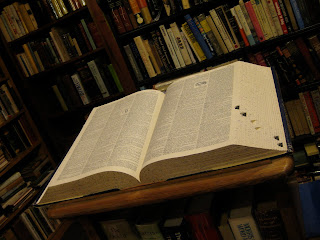
At every turn there was something nostalgic--and I use this term cautiously, because it often has a cheese-factor; something nostalgic can be seen as something with limited value or as kitchy. But nostalgia can also be a fundamental aspect of memory, triggering nigh-forgotten aspects of childhood and youth. Something like this massive dictionary, sitting on a lectern or reading stand brought back many images of bygone times for me--a dictionary similar to this still sits (usually open) in the little sun room of my grandparents home in New York.

Now the patron saint of librarians may be Saint Jerome, but the patron saint of book sellers (and vendors?--hmmmm) is Saint John of God. Or so this poster reports. By some twist of fate, I happened to be at a lecture this afternoon--April 14th--in Chicago (the same day I am writing this post) about the "construction of the idea of the saint."

The lecture, which started off with a fine vegan lunch of rosemary focaccia, fruit-infused cabbage salad, mango barley, a dash of red wine, and ending in coffee-maple granita, didn't seem to have much steam at first (save the food!), but evolved into a fine discussion about the role of "saint construction" with academic observations of hagiographic characters from Joan of Arc to Padre Pio. The discussion focused on the idea of "excess," specifically regarding how the lives and narratives of saints' lives promote the concept of excessiveness: that place beyond "legitimized centrality" in society. So, one might imagine the excess in prayer by a saint during his or her lifetime, or devotion to God through excessive practices of self-abnegation and torture of the physical self: walking miles barefoot for mass; sleeping on straw or wearing burlap sacks. These are but a few.

Yet, I wonder if there were a saint who "read too much," to fit this formula, "a reader in excess?" The scholars at this discussion were seemingly concerned with the ideas of space: that we are all living in specific spaces in the world, but that the saint lives in "that space beyond," which plays into that role, act, essence of "excess." Of course, I wonder, if this paradigm might be inwardly or reflexively cast back on the American audience, or the audience of "the West," which to others in the world may seem to live in "excess," profoundly, even grotesquely so. Yet, this is not a place beyond for those who are excessive in the West (whatever "West" really means!), nor is the West inherently "saintly." And we must remember, there are surely other criteria, which contribute to the idea and formation of saintliness, not simply some codes of conduct set by the Catholic Church.

Since we are on "saints" and "saintliness," let us turn our attention to some of the photos that are placed before us from the bookshops of Madison. One above, a joker of sorts, was painted on the wall of this same bookshop--might we make an argument for his own saintliness? An excess of laughter, or making others go beyond their space of thinking and comfort? Well, beyond the "saintliness" of the joker, we have yet another series of "saints"--how about this fine "Founders Wall," which I caught a glimpse of in a back hallway in the bookstore? I must confess that this cork-board commemoration wall seems a bit of both fact and fiction. I say this because some of these finely spectacled and mid-century dressed individuals look to be from among the circles of American "biblio-saints" and literati, like Salinger and Capote. But they may in fact be the early proprietors of the Madison book elite. I don't know. I never found out. And I apologize to my dear readers that I did not follow through on this one. Of course, I can also leave this to our own imaginations: perhaps it is better off not knowing, and letting you make your own pilgrimages to the Wisconsin capital, to discover who's who among bookish pursuits and historiography!

Certainly, I could not let a chance pass that included a shot of shelves dedicated to "books on books." Above you can see some of the choice selection from the same shop.

After my evening roam around downtown Madison, along the fine isthmus that is the center of town, I drove back toward my hotel on the western edge of the city. It was near there that I found a sprawling mall complex, which included this other new/reduced price independent book shop--the Frugal Muse. It turns out that Madison has two Frugal Muse shops. The one above was on the far west side of the city, actually outside of the city beltway itself. Here is a link for those interested: http://www.frugalmuse.com/

Back in downtown the next day, I discovered this fine para-kabbalistic, New Age "world-mind" image of Barack Obama in the window of another shop, along with other book covers. I also found this great modern mural-style painting depicting Madison aglow with planets!


As I finished up on the main block of downtown, I came across this whacky poster reading "Beat the Bookstore"--which seemed to imply some low-cost prices for students at UW-Madison. What caught my eye, though, was the image of a caffeine-crazed student tearing his way through the pages and cover of a book, with the word "frustrated?" marked underneath him! Hmmmm, that's an odd one. Actually, on a closer look, you see that he's clenching cash in his hands too. Click on the image to enlarge and see for yourself!

Heading out of town, there were a few stops to be made, but these were still in Madison itself. First, was the St. Vincent de Paul Society Thrift Store. As I may have mentioned in past postings, thrift stores often yield the greatest biblio-finds. And I must say, this branch of the St. Vincent de Paul Society had a phenomenal book section--thousands and thousands of books. AND, they were well- and neatly organized. I found, but did not purchase, a complete set of the works of Lenin in English. (For those unfamiliar with communism, see the previous post on "Un-American Activities"). The image below is from inside the SVDP Thrift Shop.


One of the recommendations I must make to you all is Lazy Jane's Cafe in Madison. Seen here from the side of the cafe, in great big Scrabblish letters, Lazy Jane's is a fine "brunchery" and more. The food is quite good, and worth any wait. When you enter, you are going into a converted old house. There's a counter, which looks like it was built into the living room, with a staircase running adjacent to it. You place your order (it may be cash only, but I'm not certain), and then you find a table, chair, or couch with a coffee table. Then you wait for the cooks to shout your name in deafening yells: "TONY!" "JANE!" "MICHELLE!" and the cling of a bell! I sat upstairs on a mid-70s chartreuse-green couch, while I waited for my seitan-bacon, eggs, and home fries. I sipped a hefty thick brew of coffee, which was delicious, and read some books and magazines piled up all over the place. Below, you will see some of the selection of children's books. Lazy Jane's was written up and recommended in the New York Times' section "36 Hours in Madison" not too long ago. So go on and check her out! It's also along a very nice street with other fine establishments, and not far from the SVDP Thrift Shop.


The last stop on this biblio-journey was to the botanical gardens in Madison, which, as we've seen before, often have their own collections of books dedicated to botany and horticulture. And sure enough, the beautiful Olbrich Botanical Gardens had their own library, the Schumacher Library, the entrance of which you can see above.

Being winter during my visit, the most apparently live-looking plants were in the conservatory, which was misty and humid. A show dedicated to carnivorous plants was in session, and visitors paying $2 for entrance fees, were greeted by Venus Fly Traps and Pitcher Plants hanging from ceiling pots! Back inside the library, I wandered around and chatted briefly with the circulation staff on duty. I was told there was a bona fide librarian on staff, which was a great thrill to hear. As you can see, even though a moderately small library, by context, it was sizable.

Before heading out, I found this little gorilla curiously eyeing a book on
English Cottage Gardens, perhaps wondering about the possibilities of topiary wonders in the British Isles. And below, I snapped a photo of some books on Poison Frogs. I started to think about this a little bit: why have a book on poison frogs in a botanical library, "frogs aren't plants!" But this goes back to another question and concern in my own library, "why have literature and sociology and American history books in a theological library?--they're not theological!" Ah, "au contraire" good people. To think like Borges, such things like "theology are part of literature," so too all things should be contextualized for their importance. And like these poison frogs, such seemingly ancillary topics are part of the ecosystem which maintains, provides, and works with the so-called main topic of a collection. Now whether you are interested in beer pong, manuscript paper, rare books, cheap books, thrift store books, or poison frog books, there is more than one place to find these objects of our affection. And books have place and purpose in seemingly out-of-the-ordinary locales, even if they don't seem to belong at first glance. Like the saintliness of excess, which we spoke of earlier, let us not think of a book's oddity of place as being "excessive" and, therefore something to be dismissed or done away with; rather, let us consider its value, ancillary or tangential, which may add greater depth and breadth to a collection, library, or book shelf. Let's not cast away the "oddities" of life. And let's face it, I'm sure in one way or another, poison frogs have saved the world. It may just take us a little while to figure out how.

 Welcome to Drazen Dupor's Studio
 Dupor Drazen (or, Drazen Dupor--depending on how you read his business card) is, according to a Madison magazine, The Daily Page (Oct. 1, 2008) by Amelia Cook "an iconographer, a painter of religious images in the tradition of Eastern Christianity. Using deep color and precise lines, his images of Christ, angels, and the saints transcend this world and stir souls. Born in Gracac, Croatia, Dupor paints in the ancient Byzantine style (think incense-filled basilica) and his work is displayed in churches, galleries, and homes worldwide." When I first spoke with Dupor, he told me that he was from "Yugoslavia" and that he'd studied for some time in Greece, so he also spoke Greek. But I could not muster anything of the modern, Attic, or Koine that would even remotely allow us to communicate in such a way. Dupor was a very kind and friendly host, showing me all of his works and the process by which he completed his works of art. (Above you can see him in the first two images).
 As it was winter, when I visited his gallery, it was very cold. Inside the gallery and workshop itself it was chilly. Though, when he led me into this back room, where he did his sketching and painting, he had a little heater, which generated an ample cloud of warmth, and afforded a more comfortable environment for working on his projects and generating good conversation. As you can see, he draws many of his icons in first by pencil, then paints in over the pencil lines.
 Looking toward the central themes of iconography, we must consider the focal text of this artistic and spiritual endeavor: the Bible. And for our good friend Dupor Drazen, it was the King James Version of the Bible, specifically. I suppose, there must be an old saying like "if it gives you inspiration, and doesn't hurt anyone --use it." And so, this lone and solitary book was perhaps the most prominent feature of this workshop: solid, hefty, regal, solemn black and white cover, with clear indications of use. In some way, just looking at this brickish book of God gave the whole room a sense of gravity, seriousness, and power. These images were here, because this artist sat around, perhaps sipping some warm tea on a bitterly cold day, flipping through the pages of scripture and thinking up the creative notions of Biblical prophecy in images as old as stone and dirt and air. Well, not quite. But old enough to emote the gravitas of monastic sublimity and spiritual ecstasy in art.


